DO Vinos de Madrid
Even though the DO was established as recently as 1990, vineyards have been cultivated here since the 12th Century. The appellation extends to four different sub-zones which surround Madrid, each within an hour’s drive of the centre of the city. To the west lies San Martín de Valdeiglesias, the smallest of these sub-zones, located in the foothills of the increasingly trendy Sierra de Gredos, a vertical mountain range that separates Madrid from Castilla y Leon.
Phylloxera arrived in San Martín in 1903. Historically, the region had supplied wine to the capital. With around 4,000 hectares planted, each village had its own co-operative cellar. But when the railway from Madrid to Valdepeñas was built, Gredos found itself unable to compete, and descended into a spiral of low prices and diminishing demand.
In the 1990s, the co-op in San Martín de Valdeiglesias handled 14 million kilos of grapes a year, yet by the 2000s this was down to just 3 million kilos. The winery finally closed its doors in 2024.
Summers are hot, rising to above 40 degrees, with sub-zero winters, with soils made up mostly of decomposed granite.
The two principal grapes grown here are Garnacha Tinta for red and rosé wines, and a relatively obscure white called Albillo Real accounts for around 3% of all plantings.
Confusion reigns over the origin of the grape, since there are around ten other regional varieties which also reference Albillo in their makeup. The name is derived from alba, meaning ‘white’ which probably explains the ubiquitous wider use of Albillo. First mentioned in 1470, some believe the variety originated in Valladolid in north-central Spain. Other theories suggest it was the other way around, with producers from Valladolid travelling south to source vine material. In Ribera del Duero, small amounts are often blended with Tinta Fina (Tempranillo). Whatever the origin, it is considered a uniquely Madrileño variety.
It’s a mildly aromatic variety which historically would be found on the table as well as in the cellar. Although not a prolific bearer of fruit, the gobelet trained vines are vigorous, with their canopies trailing onto the ground. Early budding and early ripening, yielding small bunches of medium-sized thick-skinned berries. Prone to frost, the vines perform best when planted in poor soils at higher altitudes.
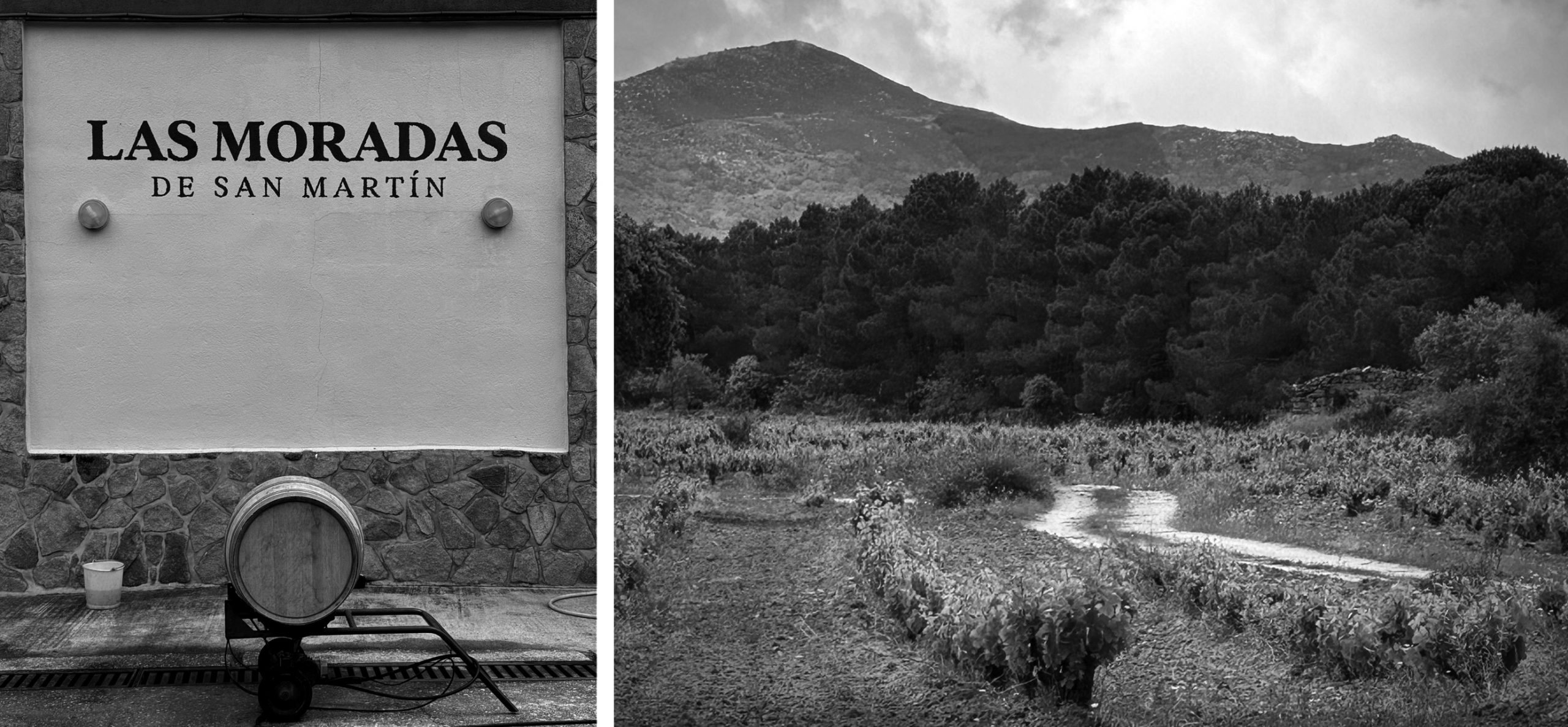
Bodegas Las Moradas de San Martín
Las Moradas is the title of the last book by Saint Teresa of Jesus, a treatise of reflective prayer written in the region. The decision to name the winery after this piece of literature has, so often in history, mentioned the wines made in the Sierra de Gredos, notably by writers of the Spanish Golden Age: Tirso de Molina, Jorge Manrique and Cervantes. The labels themselves pay tribute to Spain’s literary culture, with short passages quoted from contemporary authors.
Both vineyards and olive groves were first established here in the 12th century by the monks of the Cistercian monastery at Santa María la Real, although there are other references which date back to Roman times.
 Now one of 27 bodegas in the sub-zone, Las Moradas was officially established in 1999. Located on the Madrid side of the Sierra de Gredos mountains, with the Pago de los Castillejos being the highest in the region. The Pago has been certified organic since 2017.
The climate on this high plateau has both continental and Mediterranean influences. Despite the high daytime summer temperatures, there is a significant diurnal range which helps to negate the over-ripe and alcoholic nature usually associated with Garnacha.
 Located at an altitude of 890 metres, the site is planted to 17 hectares of Garnacha Tinta vines, the oldest of which were planted in 1908, along with 3.4 hectares of Albillo Real, a native variety which the bodega continues to rehabilitate.
All 21 hectares are trained as bush vines and cultivated without irrigation. All this sits within a unique landscape of pine forests, holm oak, juniper, rock roses, wild lavender, alongside other fynbos-like aromatic plants. The soils here are poor, yet free draining with weathered, decomposed granite mixed with deep sand. Average rainfall between 470 and 540 mm.
The modern-day history of the estate dates to the late 1990s, when Telmo Rodríguez, one of Spain’s most acclaimed winemakers, purchased a vineyard in the town of Cebreros in the Sierra de Gredos, some 30-minutes away from Las Moradas. In the same year, Telmo and some associates were brought in to offer advice and manage the Pago de los Castillejos.
At that time, there were 25 different growers, owning a total of 21 hectares of vineyards, planted almost exclusively to Garnacha Tinta. Telmo decided to extend the vineyard by planting Tempranillo and Syrah.
 In 2002, he bought in Isabel Galindo to help manage the project. Isabel had been working with Telmo in Ribera del Duero when he set up his project in the region in 1998. By 2006 however, Telmo had lost interest, leaving Isabel with a decision to make regarding her own future. By now, understanding the real potential of the vineyards, but having no funds herself, Isabel needed to find a new partner. She did so in the form of Grupo Enate, a commercially minded operation that owns 450 hectares of vineyards located in the foothills of the Pyrenees.
After many years of tracking down the lineage of ownership of those 21 hectares, the vineyards are all now fully under Enate’s ownership. Regardless, they were the first privately owned cellar to be established in San Martín.
At the same time as the Rodriguez departure, Isabel had concluded that the planting of the Syrah and Tempranillo had been a mistake. The natural acidity levels in the grapes were too low for the elevated location, climate and soil.
There were also a few old vines that were yielding white grapes. Isabel approached Imidea, the agronomy department at Madrid University, to see if the variety could be identified. The results came back confirming Albillo Real, a variety that had all but disappeared after the arrival of phylloxera.
In 2018, Isabel set about grafting cutting of the Albillo Real onto the Syrah vines. The first harvest yielded one barrel of wine. There is now a total of 3.5 hectares in production.
The wines
The Albillo Real is the sole white wine produced at Las Moradas. Although there are four different expressions of Garnacha Tinta red wines, we have consolidated our efforts in promoting just one of them.
Albillo Real
This is harvested parcel by parcel, with each plot being handled differently in the cellar. Some grapes are handled using traditional winemaking techniques, whilst others are subject to hyper-oxidation. The aim is to extract the widest expression of the variety. Fermentation is with indigenous yeasts. There is no malolactic. The wine is aged for 8 months in mostly older 500 litre French oak barrels. Bottled in the spring following the harvest. The wines are certainly capable of ageing further in bottle.
‘Senda’ Garnacha Tinta
Usually noted for its ability to oxidise easily, the Garnacha Tinto planted on this high elevation plateau is much more resilient, producing thick clusters of slightly larger berries, which result in finer, lower alcohol wines.
‘Senda’ is the mainstay of the Las Moradas production, with around 20,000 bottles produced each vintage. It comes from five different parcels, with Isabel claiming this is the most difficult wine in the range to perfect. Again, indigenous yeasts are used. Gentle pumping over in stainless steel tanks and de-vatted before the fermentation is completed. The wine is then aged for 10 months in 500 litre third to fifth-fill European oak and foudres.
All the wines are made in the cellar on the vineyard, although bottling is done at Enate’s facilities in Huelva province, Isabel states that despite the commercial effectiveness of Enate (who seem to view Las Moradas more as an indulgence than a profit-making venture), she is very much left to her own devices.
lasmoradasdesanmartin.es
| Albillo Real | pack shot | fiche 2025 |
| ‘Senda’Garnacha Tinta | pack shot | fiche 2021 |